


The IT of small and midsize companies is costly because Microsoft made the computer user-friendly and fun. Windows is like a Swiss army knife: self-contained. Little or no need for know-how at first. You learn as you go.
As computers and software have grown in power and complexity, Microsoft and Windows have absorbed the complexity: networking and servers, databases, domain controllers, Internet, mail, search, A/V, virtualization, cloud, Zero Trust, Artificial Intelligence. Each new significant technology developed by a competitor has become a new blade in the Swiss army knife. Old technologies* sit side by side with the new.
So now, the Swiss army knife is big, and you need a lot of IT support to heal the endless series of self-inflicted wounds that go with using a tool that does everything but does not do everything well.
The wounds are dull ones, and dull is why they are expensive: poor design, poor integration, bugs, and settings that do not do what they say. Here is one, and it is nobody's scandal. Microsoft is retiring RC4, a way of scrambling a password that dates from 1987. Retiring it is the right call. The cost is not the decision. The cost is the tail.
That tail is twenty-three years long. Windows learned the modern replacement in Server 2003. On Windows Server 2022 and earlier, the setting listing what a machine supports reports the 1987 method "regardless of your settings", so that older domain controllers keep working. To keep one legacy device logging in, Microsoft's guidance is to run an older Windows Server. And Microsoft keeps a mailbox for customers who still need the blade it is folding away. It is called [email protected].1
Unwinding it inside your firm is the bill. Audit two event logs, fetch two scripts, decode a table of thirty-two values, choose between two settings that configure the same thing, reset passwords, restart, then watch what breaks. Nobody attacked you. A blade from 1987 is being folded away, and the folding costs you a weekend.
So buy a tool to manage it. That is the usual answer, and it is how the knife got big. Uptime Institute reports that the software now sold to make systems resilient does improve uptime, and "can also introduce new risks and complexities", blurring who is responsible when something breaks.2 The remedy arrives as another blade. Complexity is not billed to you when you buy it. It is billed to you every month afterward.
The Microsoft and Windows universe is big and demanding, and it tends to do everything on its own terms. Don't let it. Why use a "transformer-like" multi-tool when you can use a screwdriver?
By contrast, in the Linux/Unix world, modularity and competition exist within the Operating System itself.
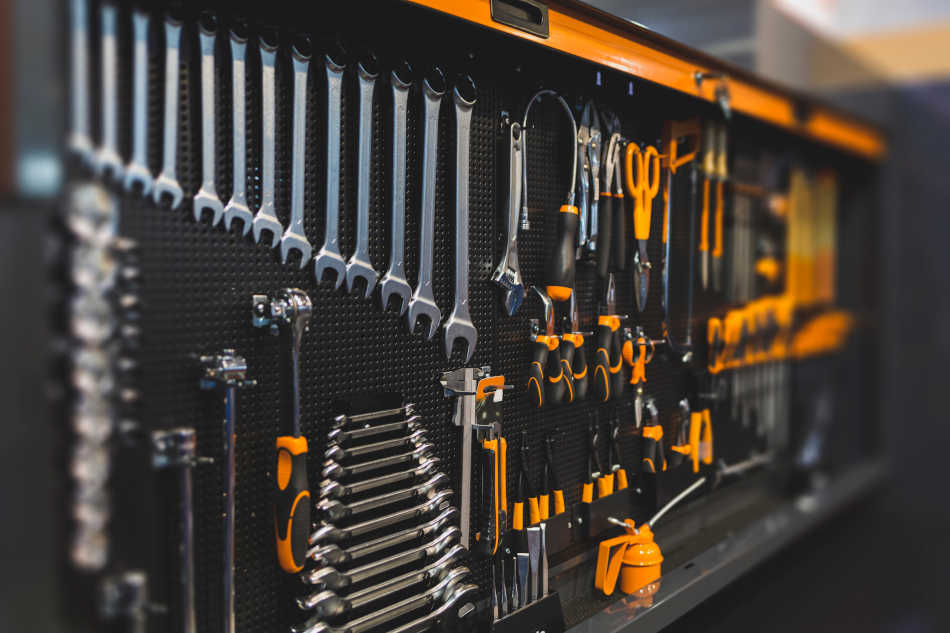
You may think of Linux distributions** as workshops, each with a workbench (the kernel) and thousands of tools neatly hung and labeled on the wall (the online repository/package manager). Debian 13, released in 2025, hangs 69,830 of them, and on its way there it retired 8,840 as obsolete.3 The wall is curated. The knife only ever grew.
Multiple software tools and methods can compete for the same job within the OS itself. Each tool is designed by its own team of software developers. The tools are tailor-made or customized for the workshop.
You pick the best tool(s) for the job and you're all set, and what you did not pick is not on the machine to go wrong. A server that was never a domain controller has no 1987 anything to unwind. This makes for lighter and better servers, and this is perfect to deliver software that everybody uses, irrespective of industry (i.e.: infrastructure software, middleware, etc.), online and within the perimeter of your network.
Use Microsoft for what it is good at (as a desktop OS, Microsoft 365 Office Suite, and Azure Virtual Desktops), but wherever "reboot, reinstall or buy more" is not an option, use the best set of dedicated tools for the job and use it for that job only.
When the only tool that can do the job is a Windows Server, so be it, but dedicate it to that job alone.***
Choosing the tool, and then holding each machine to one job, is the work. Which tool for which job has one legitimate input: what the machine is for. We steward Microsoft estates, Linux estates, and the mixed ones most firms actually have. Your staff keep the applications they know. The support bill you have been paying is not the price of IT. It is the cost of unnecessary complexity.
Concierge CIO Partners is a unified Guild of senior technologists providing dedicated, long-term fiduciary IT leadership to midmarket service firms. It offers a strategic alternative to fragile internal IT silos and to Managed Service Providers who advise you on what to buy and are paid on what you buy. With transparent unit pricing and an automated service catalog, the Guild eliminates administrative bloat and ensures every IT dollar spent and decision made directly drives your financial performance. Concierge CIO Partners: service you can order from the palm of your hand, backed by a guaranteed 15-minute return to billability.
* Networking options, permissions, etc.
** Linux distributions are versions of the Linux OS.
*** More about this here.
1 Microsoft Learn, Detect and remediate RC4 usage in Kerberos, updated 6 February 2026. 2 Uptime Institute, Annual Outage Analysis 2025, 6 May 2025. 3 Debian 13 "trixie" release announcement, 9 August 2025.